Planning 3 days in Bologna for the first time is less about finding enough things to do than deciding which places belong together. The civic square and old market are close; the university streets and Santo Stefano make another natural cluster; San Luca asks for a separate, more physical outing. Use this plan to decide what deserves your time, then open the interactive Bologna guide for the stops and map.
How should you split 3 days in Bologna?
Give the first day to Piazza Maggiore and the streets immediately around it. Spend the second between the Two Towers, Santo Stefano and the university quarter. Reserve the third for the portico towards San Luca, with a lighter afternoon back in town. This order puts your orientation first and saves the longest climb for a day without competing timed visits.
The sequence is flexible. If your best weather arrives on Day 1, swap the San Luca outing forward. If the Anatomical Theatre is a priority, secure its visit before deciding which day will be your central day. Bologna's porticoes give you shelter while walking, but they do not turn every outdoor plan into an indoor one: the San Luca ascent still needs energy and suitable footwear.
Day 1: What belongs around Piazza Maggiore?
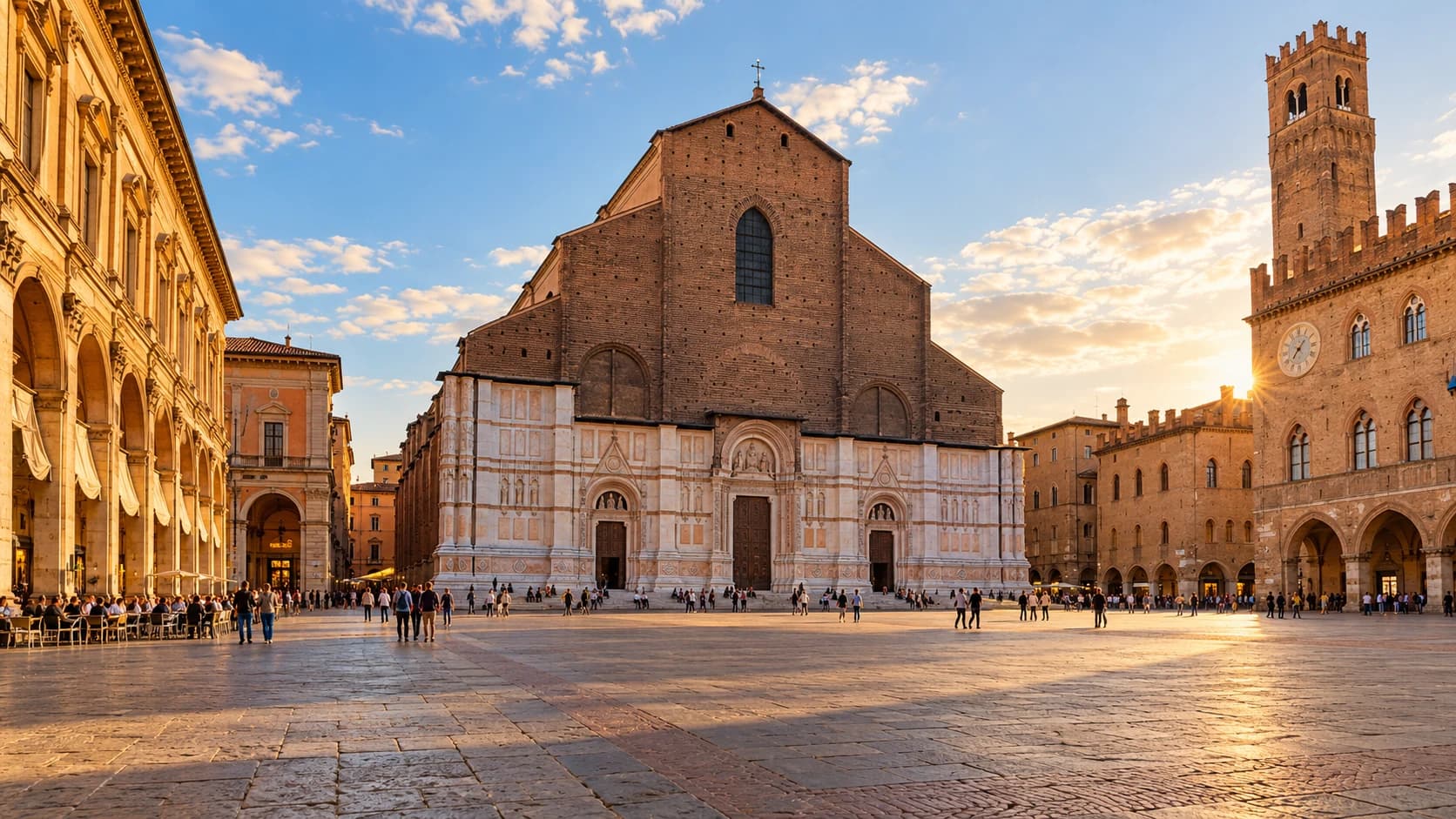
Begin in Piazza Maggiore, where San Petronio and Palazzo d'Accursio face the same civic space. Look at the square before entering anything: it gives you the scale of the old centre and a reference point for the next two days. Then choose one substantial interior, rather than treating the whole area as a checklist. San Petronio suits a visit focused on the city's religious and civic history; the Archiginnasio's Anatomical Theatre is the stronger choice if the history of learning interests you. The palace and its former teaching room tell a different story from the basilica.
Leave the Quadrilatero for a slower part of the day. The old market streets sit behind the square, so this is a good place to browse and eat without crossing town. The attraction is the pattern of narrow trading lanes as much as any particular shop. Choose somewhere you actually want to eat; a famous address is not necessary to make the neighbourhood worthwhile. Individual businesses set their own opening times, so check a specific one directly if it matters to your plan.
If you want a view over the rooftops, consider the Clock Tower on Piazza Maggiore. It is a paid visit with online booking available; check the official Clock Tower page for current access. Make it your one elevated viewpoint in the centre. A second tower visit would crowd out the more distinctive time on the streets below.
Day 2: How do the towers, Santo Stefano and university quarter fit together?
Start with the Two Towers as an exterior stop. They explain Bologna's medieval skyline, but do not build the day around climbing Asinelli: the official tourist page currently lists it as closed to visitors and Garisenda as inaccessible. Check again before travel because restoration and access can change.
Continue to Santo Stefano. Its connected religious buildings and courtyards reward a slower visit than a quick photograph of the square. The official visitor listing says access to the complex changes around services and that the main complex is closed on Mondays, so confirm the arrangements for your actual day. From there, move towards Via Zamboni and the university quarter. You will see how the porticoes function as everyday routes between streets and institutions, rather than only as a monument.
If art is your priority, spend the afternoon in the Pinacoteca Nazionale instead of adding more churches. Its collection is especially strong on Bolognese and Emilian painting, including the Carracci and Guido Reni. Check the museum's own site for current exhibitions and access. This is a substitution, not an extra obligation: the point of the day is to understand the eastern side of the centre at a pace that lets you notice it.
Day 3: Is the walk to San Luca worth a separate day?
Yes, if you enjoy walking and want to understand why the porticoes matter beyond the centre. The route begins along Via Saragozza and runs under a continuous portico from Porta Saragozza towards the Sanctuary of San Luca. At the Arco del Meloncello it changes character: the covered way turns uphill. Bologna Welcome describes the full portico as roughly four kilometres, so treat this as an outing rather than a short detour from Piazza Maggiore. The UNESCO listing covers twelve representative portico groups, including the San Luca section; the value lies in how these covered spaces connect city life, architecture and movement.
If a long climb is appealing, walk from Porta Saragozza and let the route be the day's main event. If you prefer a shorter ascent, begin nearer the Meloncello and still experience the hill section. If steep walking is a problem, keep the central porticoes as your main experience and choose another way to reach the sanctuary only after checking current transport and accessibility information. The San Luca visitor page notes that religious services can limit sightseeing inside.
Do not schedule a string of paid interiors after San Luca. Leave the afternoon for a meal, a rest or a single museum already on your wish list. This is where a three-day break gains breathing room: the walk itself, and the shift from flat streets to hillside, is the experience.
What should you book or check before you go?
Book the Anatomical Theatre online if it is central to your first day; the Archiginnasio's official page says online reservation is required for that room and the Stabat Mater Hall. A look at the palace is a different visit, so decide which you mean before planning the day. If you want the Clock Tower, check its current booking page and choose a slot that does not force you to hurry through the market.
Check San Petronio and Santo Stefano for services or special access, and check San Luca for any change to sanctuary visits. These are working religious buildings. Do not rely on a saved timetable from an older itinerary, especially across weekends or holidays. The official pages linked above are the right place for current conditions.
What should you skip if time or energy runs short?
For a two-day version, keep the Piazza Maggiore and Quadrilatero cluster, then choose either the eastern centre with Santo Stefano or San Luca. The former gives you more interiors and less exertion; the latter gives you the city's most memorable covered walk and a change of landscape. Trying to do both in the same half-day weakens each.
With three days but low energy, shorten the list within each cluster. One church or historic interior on Day 1, one on Day 2, and a shorter San Luca approach will still feel like Bologna. Skip duplicate viewpoints and a second museum before cutting the market streets or the porticoes: those are where the shape of the city is easiest to read. For different travel styles or budgets, switch the settings in the Bologna city guide rather than forcing this version to fit everyone.
Sources
- Piazza Maggiore — Bologna Welcome — Civic square and surrounding buildings.
- Basilica of San Petronio — Bologna Welcome — Basilica location and advice to check church and chapel access.
- The old market in the Quadrilatero — Bologna Welcome — Medieval trading streets beside Piazza Maggiore.
- The palace — Archiginnasio — Anatomical Theatre history and online reservation rule.
- Clock Tower — Bologna Welcome — Location, visitor access and booking options.
- The Two Towers — Bologna Welcome — Current closure of Asinelli and lack of access to Garisenda.
- Santo Stefano complex — Bologna Welcome — Complex layout and variable visit access around services.
- Pinacoteca Nazionale di Bologna — collections — Collection scope and artists for the optional museum visit.
- In the shade of the porticoes: San Luca — Bologna Welcome — Route from Porta Saragozza and the climb after Meloncello.
- Sanctuary of San Luca — Bologna Welcome — Sanctuary location and possible limits to visits during services.
- The Porticoes of Bologna — UNESCO World Heritage Centre — World Heritage scope and the civic function of the porticoes.