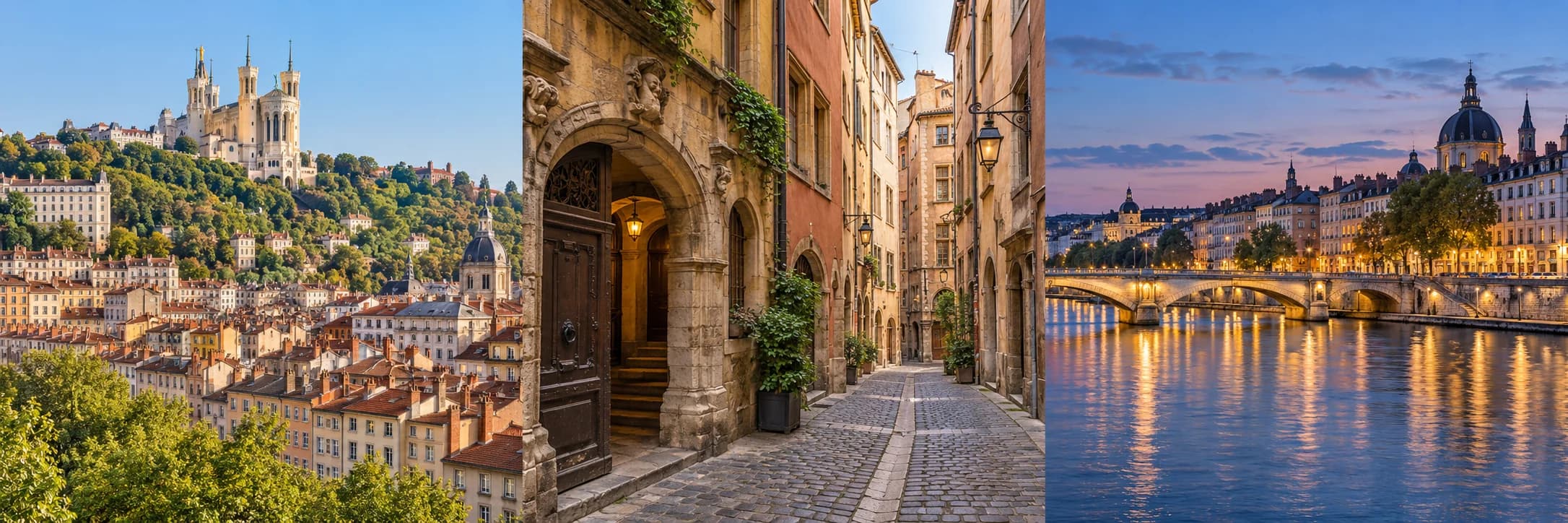
For a first visit, 3 days in Lyon can show you more than its famous old streets. Give one day to Fourvière and Vieux Lyon, one to the Presqu’île and Croix-Rousse, and one to the meeting of the rivers at Confluence. The choice that matters is how much time to spend in museums and how much to leave for the city between them.
UNESCO describes Lyon as a city shaped by two hills, Fourvière and Croix-Rousse, and by the Rhône and Saône. Its history remains visible from Roman Lugdunum to the silk-workers' slopes and the later city centre. The ThreeDaysIn Lyon guide places the stops on a map; this article helps you decide which parts deserve a full visit and which can be a walk.
How should you spend 3 days in Lyon?
Use the city's geography to avoid repeated climbs and cross-town detours. The following three areas make a useful first-time framework, but you can swap the days to match museum opening and weather.
- Fourvière and Vieux Lyon: see the Roman theatres or Lugdunum museum if that history interests you, then leave time for Saint-Jean and the Renaissance streets below the hill.
- Presqu’île and Croix-Rousse: pair the civic centre around Place des Terreaux with the former silk-workers' hill. Choose between a long neighbourhood walk and a substantial museum visit.
- Confluence and the river: explore the contemporary district at the meeting of the Rhône and Saône, with the Musée des Confluences as an optional indoor focus.
This is a decision framework, not an instruction to fit every place into every day. If you enter Lugdunum, the Musée des Beaux-Arts and the Musée des Confluences, the three museum visits will shape the trip. If you would rather see Lyon on foot, select just one and give the other days to the streets, slopes and riverbanks.
Should you start at Fourvière or in Vieux Lyon?
Start at the top if you want an easier descent. The TCL F2 funicular links Vieux Lyon with Fourvière; check its service information before relying on it. From the basilica area, you can decide whether to give the Roman theatre site and the Lugdunum museum a substantial visit or keep them as a short introduction to the city's Roman layer. Then work down towards Vieux Lyon rather than climbing back to the hill later in the day.
If Vieux Lyon's streets are your priority, reverse the emphasis: explore around Cathédrale Saint-Jean and the Saône, then go up to Fourvière for the view. The tourism office's historic-site guide describes the connection between the basilica, Vieux Lyon and the paths on the slope. Either version works; trying to complete the museum, both theatres, every courtyard and the whole old quarter in one sweep is the part to avoid.
How many traboules should you look for?
A few well-chosen passages tell you more than a hunt for every doorway. Traboules link streets through buildings and courtyards; in Vieux Lyon they reveal the old commercial quarter, while those on the Croix-Rousse slopes also connect to the history of the canuts, Lyon's silk workers. The tourism office's Vieux Lyon guide and its Croix-Rousse guide identify passages for visitors.
Choose one or two public passages in each quarter you visit, and follow the current visitor map rather than pushing at every closed door. Many courtyards are part of residential buildings. Walk quietly, make room for residents, and move on if access is closed. The street around a traboule is part of the story, not just the passage through it.
What should you pair with Croix-Rousse?
Place des Terreaux and the Musée des Beaux-Arts give the second day a clear starting point on the Presqu’île. From there, the Croix-Rousse slopes add a different chapter: passages, stairs, workshops and the legacy of silk production. UNESCO singles out the canut buildings as part of the city's historic development. If you want the walk to feel less demanding, reach the higher part of the hill first and make your way down towards Terreaux; if you start at the square, expect the climb to become a main part of the day.
Choose the art museum if it is a priority, then shorten the hill walk. Choose the full hill and its traboules if you want to understand Lyon through its streets, then leave the museum for another visit. Parc de la Tête d’Or can take the remaining part of the day if you want open space, but adding it after a long museum and hill visit may turn a pleasant option into a rushed detour. The City of Lyon's park page is the place to check current access conditions.
Is Confluence worth the third day?
Yes, if you want a change from Renaissance streets and historic hills. Confluence shows a newer Lyon at the point where the Saône meets the Rhône. The tourism office's district guide highlights its contemporary buildings and waterside walking. At the tip, the Musée des Confluences gives the day a possible museum anchor, but the riverside remains worthwhile if you do not enter.
Decide whether the museum or the river is the main event. A full exhibition visit and a leisurely walk can fill the day; a river cruise is an alternative way to see the city, rather than something every itinerary must add. If contemporary architecture holds little appeal, use the third day to return to a historic quarter or spend longer in Parc de la Tête d’Or. The best final day is the one that answers what you still want from Lyon after the first two.
Where does a food stop fit without taking over the day?
Lyon gives food a role in almost any city break, but a meal does not need to dictate a cross-city route. The Halles de Lyon Paul Bocuse is an indoor food market in the Part-Dieu area, away from the Confluence waterfront. Visit it when tasting or shopping there is one of your priorities; otherwise, eat near the area you are already exploring and preserve time for the main choice of the day.
What should you check before the trip?
Check the F2 service page if your Fourvière plan depends on the funicular. Confirm current visiting days and exhibitions with Lugdunum and the Musée des Confluences; museum schedules can change. For traboules, use the tourism office's current public-access information and respect closed doors. These checks protect the fixed parts of the plan while leaving the walks flexible.
Sources
- UNESCO — Historic Site of Lyon — The city's two hills, two rivers and successive historic districts.
- Lyon Tourist Office — Lyon UNESCO World Heritage site — Fourvière, Vieux Lyon and the connections between historic areas.
- Lyon Tourist Office — Vieux Lyon traboules — Visitor-accessible passages and residential courtyard etiquette.
- Lyon Tourist Office — Croix-Rousse traboules — Silk-worker history and passages on the Croix-Rousse slopes.
- Lyon Tourist Office — Confluence district — Contemporary district and river confluence.
- Lugdunum — museum and Roman theatres — Museum setting on Fourvière and relationship to the theatres.
- Lugdunum — opening hours and rates — Official page for current museum visiting information.
- TCL — F2 funicular — Fourvière service route and current service information.
- Musée des Confluences — official website — Museum exhibitions and current visiting information.
- Musée des Confluences — location — Museum and riverside setting at the confluence.
- City of Lyon — Parc de la Tête d’Or — Park location and current access notices.
- Lyon Tourist Office — Halles de Lyon Paul Bocuse — Market identity and location in Part-Dieu.