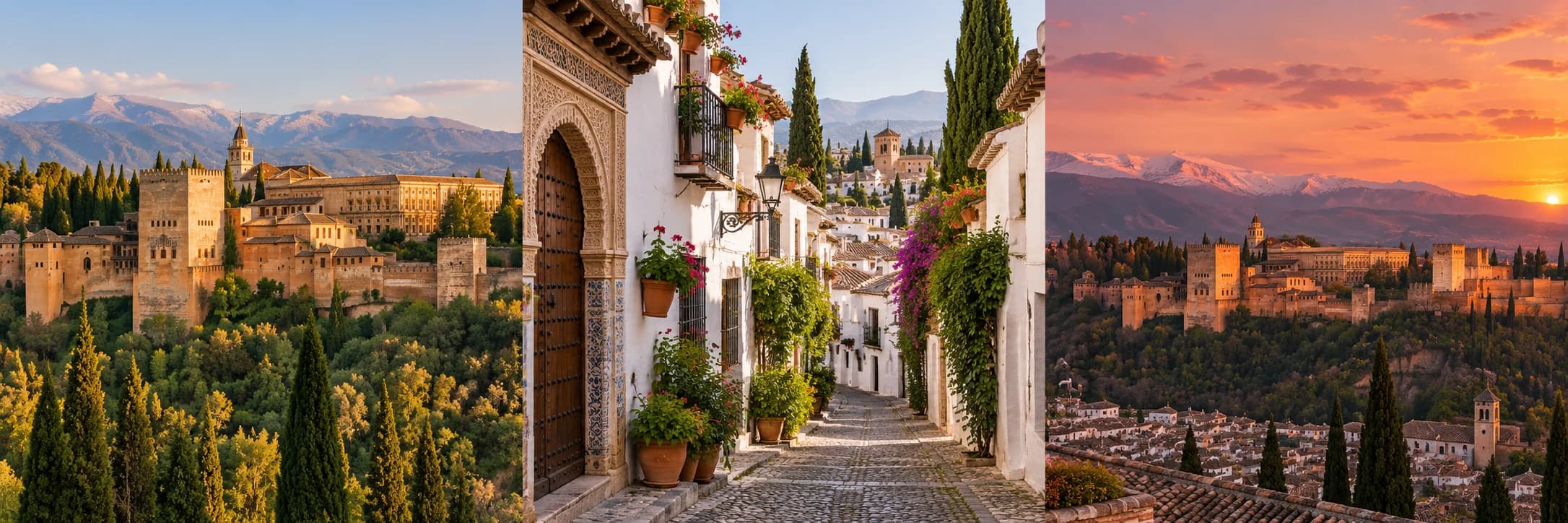
For a first visit, 3 days in Granada works best as one Alhambra day, one day on the Albaicín and Sacromonte side of the Darro, and one day in the historic centre. Book the Alhambra before assigning those days to dates: entry to the Nasrid Palaces has a time printed on the ticket, so that appointment should shape the trip.
This division follows Granada's geography as well as its history. UNESCO describes the Alhambra and Albayzín as two adjacent hills divided by the Darro. Trying to treat both as a single checklist day can leave little time to see either properly. The ThreeDaysIn Granada guide maps the stops; here is how to choose their order, depth and pace.
How should you divide 3 days in Granada?
Give each day one main area. The labels below describe the shape of the visit, not a fixed sequence: your available Alhambra entry may make its day the second or third of the stay.
- Alhambra and Realejo: build the day around your Nasrid Palaces entry. Let the Alcazaba and Generalife take the time they deserve, then use Realejo as an optional walk at the foot of the hill.
- Darro, Albaicín and a Sacromonte choice: follow the riverside into the old residential quarter, then decide whether your priority is its lanes and viewpoints or the cave landscape beyond it.
- Cathedral and historic centre: visit the Cathedral and Royal Chapel if they interest you, with La Cartuja as a deliberate extra rather than an automatic third interior.
Why should the Alhambra ticket set your schedule?
The Alhambra's official visitor guidance says to plan the order of the Alcazaba, Nasrid Palaces, Partal and Generalife around the palace entry time on your ticket. The Patronato recommends buying ahead because capacity is limited, and its ticket FAQ says a missed palace entry time means losing that part of the visit. Confirm the current rules when you book and keep your ticket and identification ready.
The Patronato gives about three hours as an average for the monumental visit. Treat that as a planning anchor, not a target to race against: reaching the hill, entering the complex and choosing where to pause all take attention. If the Nasrid Palaces slot is late, arrange the other areas around it rather than assuming you must start with the palaces. Avoid committing to a second major museum immediately afterwards.
What should you do after visiting the Alhambra?
Realejo is a natural next area if you still want to walk. The city's tourism office places this former Jewish quarter at the foot of the Alhambra, so it adds a different view of Granada without sending you across to the Albaicín hill. Choose a short wander towards Campo del Príncipe or a longer look at the quarter's streets according to your energy.
If your palace entry was late or the complex held your attention, skip the Realejo extension. It can move to another evening. The important choice is to protect the Alhambra visit from a rigid post-visit schedule; the gardens and palaces are the reason this day exists.
Can you see the Albaicín and Sacromonte in one day?
Yes, if you choose a focus instead of trying to enter every building. Begin with Carrera del Darro and Paseo de los Tristes, then move into the Albaicín's narrow lanes. The municipal Albaicín guide points to its steep streets, cármenes and viewpoints, including Mirador de San Nicolás. The neighbourhood itself is the main experience; a viewpoint is a pause, not a reason to hurry past everything on the way.
Sacromonte continues the hill-country story with cave houses and a different landscape. If the Cuevas del Sacromonte Museum or a zambra performance is a priority, allow that choice to take the later part of the day and shorten the Albaicín stops. If you would rather explore streets and viewpoints without a reservation, stay longer in the Albaicín and treat Sacromonte as an optional extension. The city's Sacromonte page explains the cave setting; its flamenco guide lists venues, but check a venue's own current programme before planning an evening around it.
What belongs on the historic-centre day?
Keep the Cathedral and Royal Chapel together. The city tourism office places the Cathedral beside the Royal Chapel and Alcaicería, making this a coherent walking area rather than a series of cross-city transfers. The two interiors tell different parts of Granada's story: the Renaissance cathedral and the burial chapel of the Catholic Monarchs. If you prefer wandering to interiors, choose one and use the saved time for the surrounding streets.
La Cartuja adds a contrasting Baroque monastery, but it is a separate commitment. Put it in the plan only if you want another substantial interior after the Cathedral and Chapel. Otherwise, end in the centre and leave time for the Alcaicería or a return to a street you passed on an earlier day. Check the Cathedral's current visitor information before fixing this day; it warns that visiting hours may change around worship and other events.
What if you cannot get an Alhambra ticket?
Check the Patronato's official ticket channel for availability and the current conditions; do not make the rest of the trip depend on a ticket you have not secured. If none is available, use the day for Realejo and another part of the centre, then keep the Albaicín and Sacromonte day. Mirador de San Nicolás gives a view across to the Alhambra, but it is a different experience from going inside the complex.
The three-area structure still helps even when the headline visit changes. Use the extra time for one or two places you would otherwise have rushed, rather than packing in a substitute list of monuments.
What should you check before the trip?
Confirm the Alhambra ticket type, date and Nasrid Palaces time on the official booking site. For the centre, check current visiting information for the Cathedral and any other interior you intend to enter. If mobility, a pushchair or uneven ground is a concern, review the Alhambra's accessibility guidance and plan the Albaicín's steep lanes with the same care. These checks matter more than filling every gap in the schedule.
Sources
- Patronato de la Alhambra — organise your visit — Main visit areas, timed Nasrid Palaces entry and average visit duration.
- Patronato de la Alhambra — visitor FAQ — Ticket conditions, identity checks, missed entry times and accessibility.
- Patronato de la Alhambra — official ticket advice — Advance-booking advice and official availability checks.
- UNESCO — Alhambra, Generalife and Albayzín — The relationship of the Alhambra, Albaicín and Darro landscape.
- Granada tourism office — Albaicín — Neighbourhood terrain, cármenes and viewpoints.
- Granada tourism office — Realejo — The quarter's location below the Alhambra and its streets.
- Granada tourism office — Sacromonte — Cave houses and the quarter's landscape.
- Granada tourism office — flamenco — Sacromonte zambras and the need to check current programmes.
- Granada tourism office — Cathedral and Royal Chapel — Cathedral location and its relationship to the Royal Chapel and Alcaicería.
- Granada tourism office — Royal Chapel — The chapel's history and relationship to the Cathedral.
- Granada tourism office — La Cartuja — The monastery's Baroque character.
- Granada Cathedral — visiting information — Official notice that visiting hours can change.