Is a Venice vaporetto pass worth it for three days? Only if your plans call for enough boat journeys. You can walk between many sights in the historic centre, while a lagoon-island outing or several Grand Canal rides changes the calculation. Decide where you will travel by water first; then compare the current ACTV ticket prices.
The ThreeDaysIn Venice guide groups San Marco and Castello, Rialto and Dorsoduro, then Cannaregio and a lagoon choice. Those areas help you count likely rides without treating every stop on a map as a separate ticket. For the choice between a city day and an island day, see our three-day Venice neighbourhood plan.
Is a three-day Venice vaporetto pass worth it?
There is no universal answer. ACTV sells a 75-minute ticket and passes valid for 24, 48 and 72 hours from first validation. The right comparison is between the journeys you intend to take during those hours, not the number of nights you booked. Check the current ACTV fares and validity rules before buying.
- Mostly on foot: if your days stay within the historic centre and you want just one Grand Canal ride, start by comparing individual tickets. A 72-hour pass may cover far more journeys than you will use.
- One island day: compare a 24-hour pass with the separate tickets needed for your planned outward, connecting and return journeys. If you will move between islands, count each boarding rather than assuming a single short ticket covers the whole outing.
- Boats on several days: compare the 48- and 72-hour passes with your full list of rides. A longer pass may also suit you if walking over many bridges is difficult, but check the route to each stop before paying for convenience you cannot use.
How do you compare Venice transport tickets for three days?
Make a rough journey list before opening the ticket page. Write down your arrival point, accommodation, each day's farthest destination and the return to your departure point. Mark a journey as a boat ride only when walking would be impractical or when the ride itself is part of your visit. This prevents a pass from looking attractive simply because the city is surrounded by water.
Then compare the total cost of individual tickets with a 24-, 48- or 72-hour pass using the official Venezia Unica ticket page. Note the time of each boarding: a valid 75-minute ticket can cover a transfer, provided you validate again when changing vehicle. Place your likely first and last rides on a timeline, too. ACTV says the multi-day periods run from the first validation, so a pass bought for three calendar dates might expire before your final journey if you start it early on day one. If most rides fall on the island day, a one-day pass plus individual tickets on other days may fit better. These are planning comparisons, not a promise of the cheapest fare; fares and product terms can change.
Where can you walk instead of taking a vaporetto?
For the guide's first day, San Marco and Castello work as a connected walk. On the second, Rialto, San Polo and Dorsoduro form another walking day. A boat can still be useful for reaching your starting point or getting home when tired, but it need not carry you between every attraction. Venice's lanes and bridges are part of the visit; a pass does not make a boat the quickest or most direct choice for every short hop.
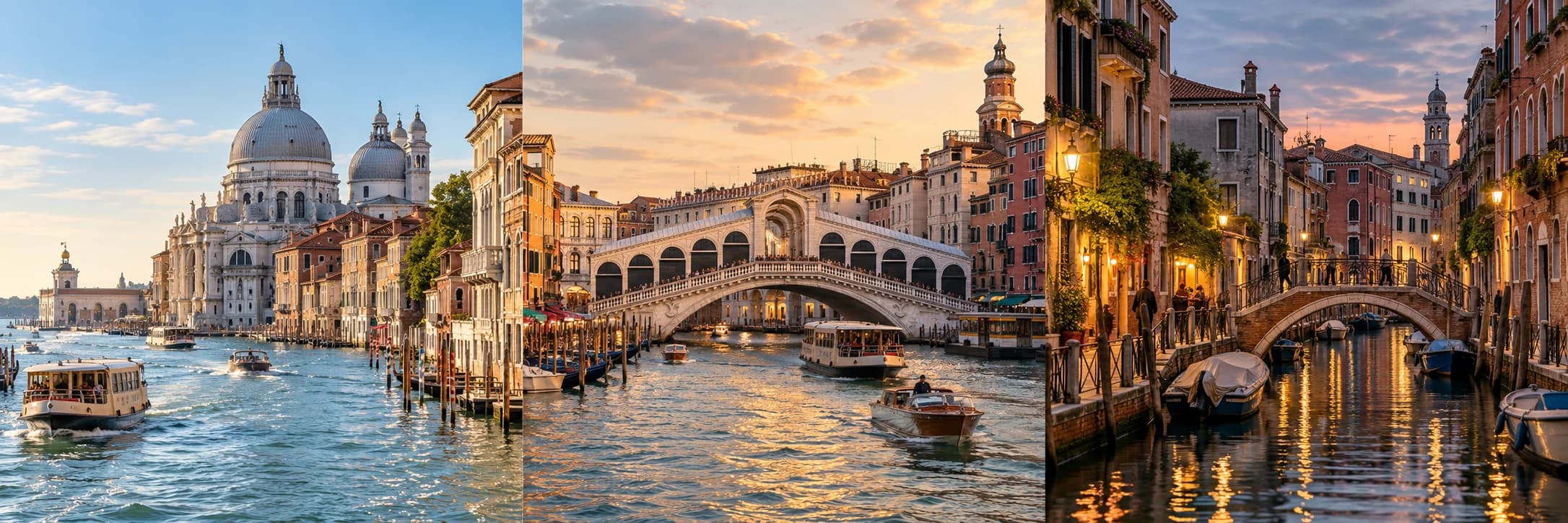
Keep one water journey if seeing the Grand Canal from the boat matters to you. ACTV identifies central routes along the Grand Canal and Giudecca Canal, but the route you want depends on your boarding and exit stops. Check the current ACTV map, including the stop name and direction, rather than choosing a line from an old travel post.
Does a lagoon-island day change the ticket choice?
Yes, because walking cannot replace the water connection to Murano or Burano. The Venice guide offers a lagoon choice on day three: for a short stay, choose the island you most want to see before adding another. A single island visit needs an outward and return journey; visiting more than one may add transfers and more time on the water. This is the day most likely to make a time-limited pass useful, especially if you also want a Grand Canal ride.
Check the exact stops and services on the ACTV route map, then look at the operator's live timetable and notices before you leave. Choose the ticket after you know the route. A pass cannot recover time lost by trying to fit several islands into a day you also wanted to spend in Cannaregio.
Does the vaporetto pass include Marco Polo Airport?
Do not assume it does. ACTV's standard 24-, 48- and 72-hour tickets exclude its routes to and from Marco Polo Airport unless you buy the relevant airport supplement; the three-day ticket page flags this exclusion. Alilaguna airport boats are a separate service and are also excluded from standard ACTV tickets. Compare your airport transfer on its own, then count city and island journeys for the pass decision.
If you are eligible for Rolling Venice, check its current 72-hour transport offer on the official Rolling Venice page. Verify the age rule, what is included and any airport option before paying; a discounted offer only helps if it matches your trip.
What should you check before boarding?
ACTV requires validation at the start of each journey and when you change vehicle, including with a time-limited ticket. At the stop, confirm the platform, destination and direction on the current display. The operator publishes timetables and service notices, and warns that services can be modified, so leave room around a flight or train connection.
If bridges or steps affect your route, check Venice's accessible-journey information before deciding to walk or ride. The city's MoveIn tool highlights barriers and accessible routes; it is particularly useful when travelling with a wheelchair, pushchair or heavy luggage. A ticket choice should follow a route you can actually use.
Sources
- ACTV — Venice urban services and ticket validity — Ticket durations, validation, airport exclusions and Alilaguna exclusions.
- Venezia Unica — public transport tickets — Official comparison of current ACTV ticket products and fares.
- Venezia Unica — ACTV three-day transport — Three-day product and airport exclusion.
- ACTV — waterborne route map and stops — Current route map and named waterbus stops.
- ACTV — moving in Venice — Pedestrian network and central, lagoon and island waterborne route groups.
- Venezia Unica — Rolling Venice — Eligibility signpost and 72-hour transport offer.
- Venezia Unica — Accessible Venice — Accessible route planning and the MoveIn tool.
- ACTV — general transport conditions — Validation requirements, timetable notices and service changes.