Planning Kyoto with kids for three days is less about finding child-friendly places than deciding how many famous places a family can enjoy before the day turns into a transfer exercise. The family version of our Kyoto guide includes Fushimi Inari, Higashiyama, Arashiyama Monkey Park and Kyoto City Zoo. They make a strong starting list, but they do not all deserve equal time on every trip.
Think in three areas: a southern shrine and eastern streets, a day in western Arashiyama, then a choice between central Kyoto and the zoo in eastern Okazaki. Kyoto's official area guide treats Fushimi, Higashiyama, Arashiyama and Okazaki as distinct districts. With children, crossing between them is part of the day's effort. Choose one main experience each morning and make the second half of the day conditional on everyone's energy.
What is a realistic three-day Kyoto plan with kids?
- Day 1 — Fushimi Inari and a selective Higashiyama walk: see the shrine first, then decide whether Kiyomizu-dera or an easier walk towards Gion is the right second stop.
- Day 2 — Arashiyama: make the bamboo grove and riverside the base; choose either the Monkey Park climb or a longer temple and garden visit.
- Day 3 — space to move: use Kyoto Gyoen and one cultural stop, or make Kyoto City Zoo in Okazaki the main event. Treat the remaining temples as options.
This is deliberately lighter than ticking off every stop in the guide. It leaves a decision point after lunch instead of a promise to be across town at a fixed time. Families with older children who enjoy long walks can add more; families with toddlers may have a better trip by keeping just the morning anchor.
Can you combine Fushimi Inari and Kiyomizu-dera with children?
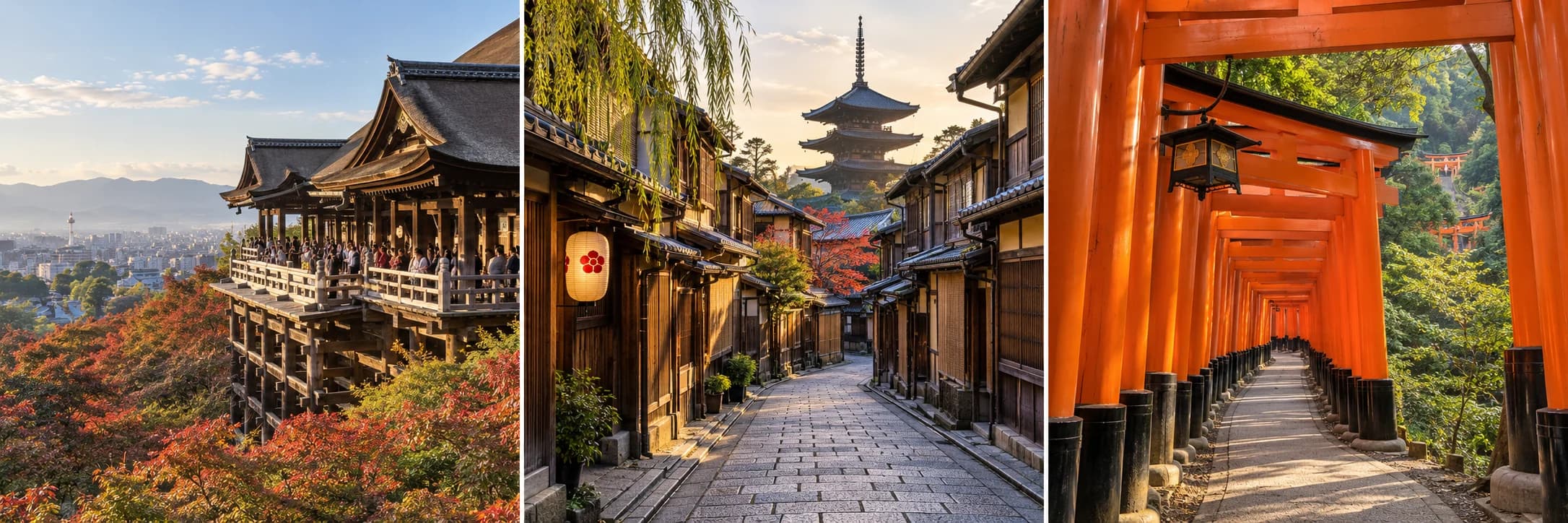
Yes, if you treat them as two separate visits, not one continuous stroll. Fushimi Inari is in southern Kyoto; Kiyomizu-dera is in eastern Higashiyama. At the shrine, decide in advance that turning back before the mountain route is a valid plan. Children can appreciate the sequence of torii gates without completing a summit walk. The shrine's map shows how much more there is beyond the lower precinct, and its visitor requests ask people to keep narrow paths clear and eat only in designated areas. Save snacks for a proper pause.
After a break and the cross-city journey, choose Kiyomizu-dera only if the group still wants another substantial visit. Its main hall stands on the hillside and the surrounding lanes add walking; the temple's own visitor page shows the grounds before you commit. If that feels too much, spend the afternoon around Yasaka Shrine and Maruyama Park, then take a short look at Gion. The city's family guide identifies Maruyama Park as a useful family pause. Nishiki Market can wait for another day rather than becoming an obligatory third destination.
Is Arashiyama Monkey Park worth the climb for your family?
The Monkey Park is the clearest difference between a standard sightseeing day and the family's Arashiyama day in the guide. It offers an encounter with free-roaming macaques, but the visitor centre is up a hillside: this is a walk to choose, not a quick stop between the bamboo grove and lunch. Kyoto City's description of the park also explains the animal rules: keep your distance and feed monkeys only from inside the visitor centre, through its fence. Check the park's current opening details before you set out.
If your children are keen walkers and interested in animals, do the bamboo grove and then make the park the day's main activity. Keep the rest of Arashiyama loose. If a hill walk or close contact with animals will be difficult, skip it without trying to replace it with a second long transfer. Tenryu-ji's garden is in the same Arashiyama area, and the river and Togetsu-kyo Bridge give the day a different pace; the official tourism page for Tenryu-ji describes its pond garden.
The full family itinerary also names Kinkaku-ji and Ryoan-ji after Arashiyama. They are worthwhile northwest Kyoto visits, but adding both turns the day into a chain of moves. If the Monkey Park is your priority, let those temples go. If the children would prefer gardens and shorter stops, skip the park and consider one of the two temples after Arashiyama. Decide before you leave the area rather than treating both as compulsory.
Should day three be a zoo day or another temple day?
The guide's third family day includes Kyoto Imperial Palace and Kyoto Gyoen, Nijo Castle, Kyoto City Zoo, Ginkaku-ji and the Philosopher's Path. These are several distinct visits, not one neighbourhood walk. Start with the question your children can answer: would they enjoy more historic buildings today, or do they need a day led by animals and open space?
For the animal-led version, make the Kyoto City Zoo the main visit and leave time for nearby Okazaki Park. Kyoto's official family page places the zoo among its child-focused stops and identifies Okazaki Park as the surrounding cultural area. If everyone still wants more of eastern Kyoto, choose Ginkaku-ji or a short section of the Philosopher's Path afterwards, not both by default. Check the zoo's calendar and admission information on its website before travelling.
For a quieter history-led version, use Kyoto Gyoen as the open-air start and choose Nijo Castle as the one cultural stop you plan around. The zoo then becomes a swap, not an addition. A family that has already had two long sightseeing days might simply stay in the garden longer. That is still a Kyoto day, and it gives the children room to shape it.
How do you reduce travel friction between Kyoto's family stops?
Build each day around an area, then check the actual route between the two places you have kept. The city's transport guide groups attractions by district and recommends combining rail, subway and buses according to the destination. Do not assume one bus is the simplest choice just because it looks direct on a map; the bus guide tells visitors to check the stop and direction before boarding.
Keep a small fallback for each day: a park near the planned sights, a shorter shrine or temple circuit, or an earlier return to your base. Check current opening days, access and any ticket conditions on the linked official sites, especially for the Monkey Park and zoo. If you are travelling with a pushchair, check the relevant venue's route before committing to a hillside visit. The best family version of Kyoto is the one that still has energy left for tomorrow.
Sources
- Kyoto Travel — Getting Around Kyoto — Official district and transport guidance used to keep days geographically coherent.
- Kyoto Travel — Families with Kids — Official family attractions and park locations, including the zoo, Okazaki and Arashiyama Monkey Park.
- Fushimi Inari Taisha — Inariyama and Visitor Requests — Shrine visitor etiquette, including rules for narrow paths and eating.
- Fushimi Inari Taisha — Inariyama — Official description of the mountain path beyond the lower shrine.
- Kiyomizu-dera — Visit — Official grounds map and hillside setting.
- Kyoto City — Arashiyama Monkey Park Iwatayama — Municipal description of the hillside park and visitor rules.
- Kyoto City Zoo — Official Website — Official calendar and visitor information for checking current details.
- Kyoto Travel — Tenryu-ji Temple — Official description of Tenryu-ji's Arashiyama garden.
- Kyoto Travel — Getting Around Kyoto by Bus — Official advice to check bus stop locations and directions.