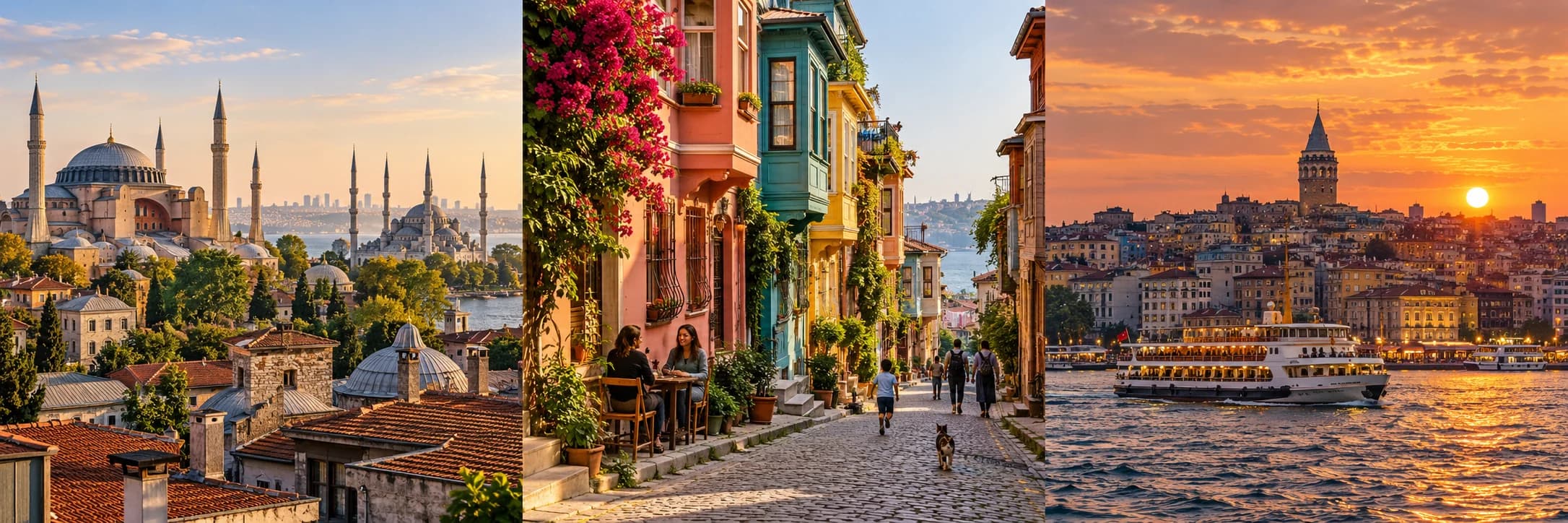
Istanbul rewards couples who walk, ride the ferries and let the city's neighbourhoods set the pace. That is also the cheapest way to see it. The headline sights sit close together, the public transport network covers the rest, and some of the best moments of the trip, such as a crossing of the Bosphorus at the end of the day, do not depend on a big budget.
This itinerary is organised by neighbourhood rather than by checklist: Sultanahmet and the historic peninsula on day one, Eminönü, Galata and Beyoğlu on day two, and Kadıköy on the Asian side on day three. Each day keeps walking distances realistic, leaves room to sit down with a tea, and avoids doubling back across the city.
We deliberately do not quote entry fees, ticket prices or opening hours here. They change, and several sights have revised their visiting arrangements in recent years. Where it matters, we point you to the official source to check before you go. If you would rather see the whole plan on a map, with every stop in order, open the interactive 3-day Istanbul guide for couples on a budget.
Day 1 — Sultanahmet & Historic Istanbul
Start where the city's story is easiest to read. Sultanahmet is compact, and almost everything on day one can be done on foot. The area belongs to the Historic Areas of Istanbul, inscribed on the UNESCO World Heritage List.
Sultanahmet Square and the Blue Mosque
Begin in the park between the Blue Mosque (Sultan Ahmed Mosque) and Hagia Sophia, ideally early, before the tour groups arrive. The Blue Mosque is an active place of worship, so plan around prayer times, dress modestly (shoulders and knees covered, and a headscarf for women) and be prepared to remove your shoes.
Hagia Sophia
Hagia Sophia has served as a church, a mosque, a museum and, since 2020, a mosque again. Visiting arrangements, including how and where foreign visitors enter and which parts require a ticket, have changed in recent years. Check the current rules on the day rather than relying on an older blog post, and decide together whether going inside is worth your time and budget. Seeing it from the square costs nothing, and it is just as striking at dusk.
Historic streets and Gülhane Park
Walk downhill toward Gülhane Park, the former outer gardens of Topkapı Palace. It is one of the most pleasant places in the historic peninsula for a break, with shade, benches and a viewpoint over the point where the Golden Horn, the Bosphorus and the Sea of Marmara meet. Take the smaller side streets on the way rather than the main tram avenue, where you will see the older wooden houses and neighbourhood shops that visitors often miss.
A budget-friendly evening
Skip the restaurants facing the main squares, which are aimed squarely at tourists. Instead, walk a few streets away and look for an esnaf lokantası, a traditional tradesmen's restaurant that serves home-style dishes from a counter. Because the dishes are on display, you can see what you are ordering before you commit. Afterwards, return to the square for a quiet walk when the mosques are lit up.
Day 2 — Eminönü, Galata & Beyoğlu
Day two moves across the Golden Horn and uphill. It is the most walkable day, but also the one with the steepest streets, so wear comfortable shoes.
Spice Bazaar and the waterfront at Eminönü
Take the T1 tram to Eminönü, or walk down from Sultanahmet. The Spice Bazaar (Mısır Çarşısı), part of the New Mosque complex, is a sensory way to start the day. Browsing costs nothing, so compare a few stalls before buying and ask about prices first.
Galata Bridge and Karaköy
Walk across the Galata Bridge toward Karaköy. The upper deck is lined with anglers, and the view back toward the historic skyline is one of the best free views in the city. On the far side, Karaköy is a former port district that now has independent coffee shops, small galleries and old hardware stores side by side.
Galata and Beyoğlu
Climb into the Galata neighbourhood, where the medieval Galata Tower anchors a web of narrow streets. You do not need to go up the tower to enjoy the area. The surrounding lanes, with their cafés and shops, are the real draw. To save energy for the evening, you can take the Tünel, a short underground funicular that connects Karaköy with the top of the hill, instead of walking.
From there, walk down İstiklal Avenue, the long pedestrian street through Beyoğlu. The street itself is free, and the historic tram that runs along it is a pleasant photo stop. For a quieter experience, step into the side streets and passages away from the main crowd.
Affordable dining in Beyoğlu
Dining on or just off İstiklal ranges from excellent to overpriced. A reliable rule is to move one or two streets away from the busiest stretch and to look at where local people are eating. Meze to share, a main dish and tea afterwards is usually a better value than a full set menu aimed at visitors.
Day 3 — Kadıköy & the Asian Side
On the last day, leave the historic peninsula behind and cross to Asia by public ferry. It is one of the best-value experiences in Istanbul: a Bosphorus crossing that doubles as a scenic cruise.
The public ferry to Kadıköy
Ferries to Kadıköy leave from the piers at Eminönü and Karaköy. Check the current timetable on the Şehir Hatları website before you set off, and sit on the outside deck if the weather allows. Keep an eye out for the old Haydarpaşa railway terminal as you approach the Asian shore.
Kadıköy and its markets
Kadıköy feels more everyday than the old city. The market streets behind the ferry pier are full of fishmongers, pickle sellers, bakeries and cafés, and the area is a good place to eat well without spending much. Walk the lanes at your own pace, and pick up something small to share in a nearby park.
Moda waterfront
From Kadıköy, walk or take a short local ride to Moda, a residential neighbourhood with a seafront promenade, parks and relaxed cafés. The water here opens toward the Sea of Marmara, which makes it a natural place to slow down.
A relaxed final evening
Stay in Kadıköy for dinner, then take the ferry back as the light fades. Seeing the lit-up silhouette of the historic peninsula from the water makes for a good last memory, and it costs about the same as any other local ferry ride.
Practical Budget Tips
Public transportation
Istanbul's trams, metro lines, buses, funiculars and ferries are integrated enough that most visitors rely on a single contactless transit card, the Istanbulkart. Check the official Istanbul Metro website for current lines, maps and fare information, and the Şehir Hatları site for ferry timetables. Avoid taxis for short hops in the old city, where traffic can be slow and walking is often quicker.
Neighbourhood-based planning
Istanbul is large, and crossing it repeatedly eats time and money. Group your days by area, as in this itinerary, and you spend less on transport and more time actually enjoying the city.
Free versus paid experiences
- Usually free or very low-cost: walking the Galata Bridge, İstiklal Avenue and the Moda waterfront, relaxing in Gülhane Park, browsing the markets, and seeing major monuments from the outside.
- Worth paying for, if they matter to you: interiors of selected monuments and museums. Pick one or two a day instead of trying to see everything.
- Best value: the public ferry, which gives you a Bosphorus cruise at the price of a regular transit fare.
Affordable dining
Eat where residents eat: traditional lokanta counters, bakeries, market stalls and simple grills. Walking two or three streets away from the main sights usually improves both the price and the quality. Share dishes where you can, and ask about prices before ordering if the menu does not list them.
Choosing accommodation
- Sultanahmet: closest to the day-one sights and quiet in the evening, but with fewer everyday options for food.
- Karaköy, Galata or Beyoğlu: lively, central and well connected, with plenty of cafés and restaurants, though the streets are steep.
- Kadıköy: a local feel and good food, with a ferry connection to the old city, but further from the main sights.
FAQ
Are three days enough for Istanbul?
Three days is enough for a satisfying first visit that covers the historic peninsula, the Golden Horn and Beyoğlu, and a taste of the Asian side. It is not enough to see everything, so choose a few things to do well rather than trying to cover the whole city.
Is Istanbul affordable for couples?
It can be, particularly if you rely on public transport, eat at local restaurants and pick your paid sights carefully. Prices and exchange rates change often, so check current costs close to your trip rather than relying on figures from older articles.
Do you need a car in Istanbul?
No. Traffic can be heavy, parking is difficult in the historic areas, and the combination of walking, trams, metro and ferries covers everything in this itinerary.
Where should couples stay?
It depends on what you want. Sultanahmet suits first-time visitors who want to be near the main sights, Karaköy, Galata and Beyoğlu suit couples who want restaurants and nightlife on the doorstep, and Kadıköy suits those who prefer a local atmosphere. See the accommodation notes above for the trade-offs.
Plan your own three days
Use this article as a starting point, then build the trip around your own pace. The ThreeDaysIn Istanbul guide maps each day, lists local places to eat and lets you adjust the plan by budget and travel style.
Sources
- Istanbul Metro — official website — Metro, tram and funicular lines, maps and fares.
- Şehir Hatları — ferry timetables — Official city ferry timetables, including routes to Kadıköy.
- UNESCO World Heritage Centre — Historic Areas of Istanbul — Background on the historic peninsula.