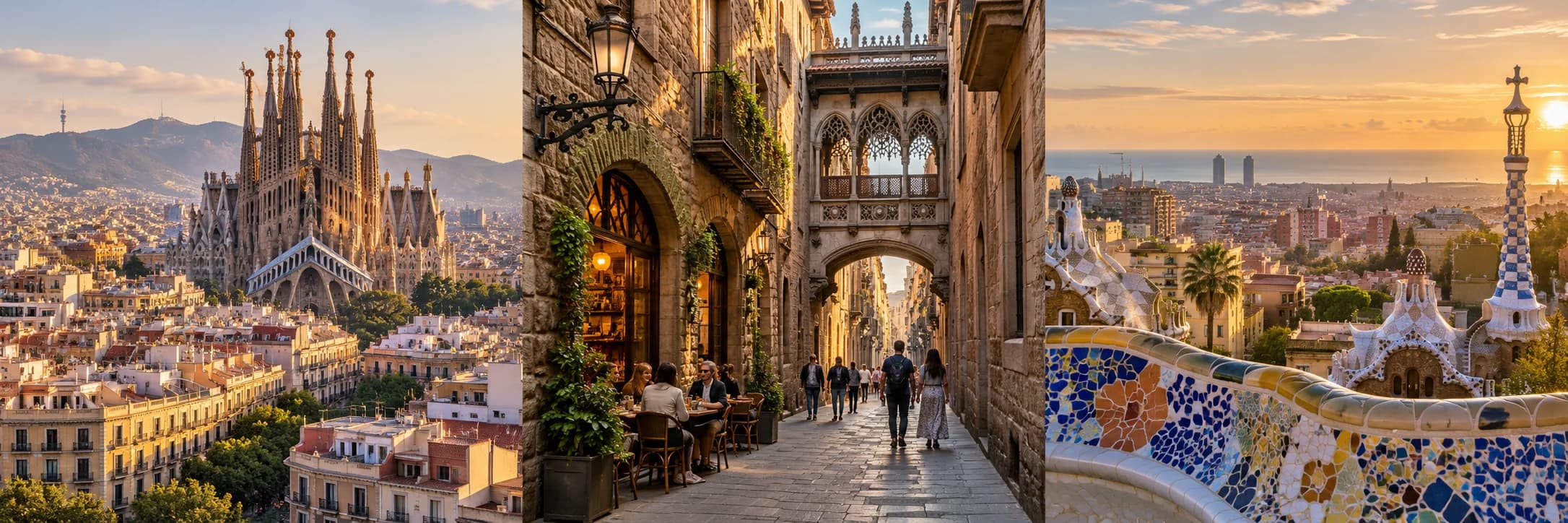
Most Barcelona stops can be moved around on the day. The Sagrada Família cannot. Its official pages describe a timed ticket, in your name, bought online, and they are clear that arriving late means not getting in. That makes it a fixed point, and fixed points should be placed first when you plan the rest of the trip.
This article covers how that ticket works, what the entry rules mean for your day, and how to fit the visit into a short stay. It sits alongside our Barcelona guide, which places the Basílica de la Sagrada Família in Eixample and allows about 90 minutes for it.
How the Sagrada Família ticket works
According to the official FAQ, tickets can only be purchased online, through the official app or the website. The same page says tickets can currently be bought roughly two months before the visit, and that they are valid only for the time you choose.
Three details change how you plan:
- The slot is rigid. The FAQ states that if you arrive late you will not be able to enter. Treat your slot time as a deadline, not an estimate.
- The ticket is personal. The rules and regulations say tickets are nominative and non-transferable, and the FAQ asks for official photo ID, such as a national ID card or a passport. Bring the right document for every person in your group.
- Changes are limited. The FAQ says that, as a general rule, no ticket exchanges or returns are allowed. Choose your date once you are sure of your other bookings.
Because tickets go on sale about two months ahead, the practical advice is simple: if the Sagrada Família is the reason for your trip, book it as soon as your dates are fixed, then arrange the rest around it.
Where it fits in a short Barcelona stay
The ticket's rigidity is also the reason to protect it. Pick the day when your other plans are loosest, and choose a slot that leaves slack on both sides. If you build the day tightly around the slot, a late metro or a long queue elsewhere can cost you the entry itself.
The 3-day solo plan makes the same point from a different angle: sort the fixed points first, then let the rest of the day flex. The Sagrada Família is the clearest fixed point in the city.
Our guide treats it as roughly a 90-minute visit. The official pages do not state a typical duration, so use that as a planning figure rather than a promise, and leave extra time for entry.
Entry rules that affect your day
The official rules are specific, and a few of them are easy to get wrong on the morning.
- Dress code. The rules ask visitors to dress appropriately, because it is a Catholic church. They list no see-through clothing, trousers and skirts to at least mid-thigh, no swimwear and no entering barefoot. Hats are not allowed in the nave or the museum except for religious, health or belief reasons, and bare shoulders are not allowed in the Chapel of the Holy Sacrament.
- Bags. The FAQ says bags, rucksacks and luggage are checked on entry and that admission can be refused. It also says there are no lockers for suitcases, so do not arrive straight from the station with a case.
- Photography equipment. The rules page restricts photo, video and sound-recording equipment inside the Basilica and requires media authorisation for professional equipment. Read that page before you pack a camera.
Individual visitors use the general entrance on the Nativity façade, on Carrer de la Marina, according to the schedules and access page. The same page lists the metro stop as Sagrada Família, on lines L2 and L5.
Towers, accessibility and groups
The FAQ says all of the Basilica is accessible except the towers, and that visitors with disabilities or reduced mobility use entrance B on Carrer de la Marina, where wheelchairs are available subject to availability. It also says bags can be left only while visitors climb the towers, because no bags or rucksacks are allowed up there.
For groups, the tickets page describes individual tickets for up to nine people, and the rules treat any party of ten or more as a group needing an accredited official guide. If your party is close to that number, check which category applies before you book.
What you are actually visiting
The official history page says the project was first designed by Francisco de Paula del Villar, with Antoni Gaudí taking over in 1883, and that construction continues more than 140 years after the cornerstone was laid. It records that the Nativity façade and crypt were named UNESCO World Heritage in 2005.
It also records recent milestones: the tower of Jesus Christ was completed on its upper arm in February 2026, finishing the exterior of the central tower, and it was blessed and illuminated for the first time in June 2026. So the building you see is a working site as well as a monument, which is worth knowing when you set your expectations.
FAQ
Can I buy Sagrada Família tickets at the door?
The official site says tickets can only be purchased online, through its official app or website. It also mentions direct-purchase QR codes around the Basilica, with availability based on occupancy at the time, so do not count on a same-day slot.
Do I need ID to enter the Sagrada Família?
Yes. The official pages say tickets are nominative, personal and non-transferable, and that an official photo ID is required: a national ID card or a passport.
What happens if I arrive late for my slot?
The official FAQ says tickets are only valid for the time chosen and that if you arrive late you will not be able to enter.
Is the Sagrada Família accessible?
The official FAQ says the whole Basilica is accessible except the towers, and that visitors with disabilities or reduced mobility use entrance B on Carrer de la Marina.
Sources
- Sagrada Família — FAQ (official) — Online-only tickets, timed entry, ID, bags and accessibility.
- Sagrada Família — Rules and regulations (official) — Dress code, equipment rules, nominative tickets and groups.
- Sagrada Família — Schedules and how to get here (official) — Entrances and metro lines.
- Sagrada Família — History of the temple (official) — Designers, UNESCO 2005 and recent construction milestones.
- Sagrada Família — Tickets (official) — Ticket categories and group sizes.